Alexander Calders Mobiles Are Examples of Kinetic Art Because They

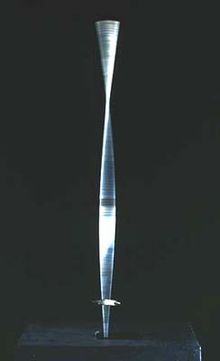
Naum Gabo, Kinetic Construction, also titled Standing Wave (1919–20)
Kinetic art is art from whatsoever medium that contains movement perceivable by the viewer or that depends on move for its upshot. Canvas paintings that extend the viewer's perspective of the artwork and incorporate multidimensional motion are the earliest examples of kinetic art.[1] More than pertinently speaking, kinetic art is a term that today most oft refers to three-dimensional sculptures and figures such every bit mobiles that move naturally or are automobile operated (meet due east. g. videos on this page of works of George Rickey, Uli Aschenborn and Sarnikoff). The moving parts are by and large powered past air current, a motor[two] or the observer. Kinetic art encompasses a wide diverseness of overlapping techniques and styles.
There is also a portion of kinetic art that includes virtual movement, or rather movement perceived from only sure angles or sections of the work. This term too clashes frequently with the term "apparent movement", which many people use when referring to an artwork whose movement is created by motors, machines, or electrically powered systems. Both credible and virtual motility are styles of kinetic art that just recently have been argued as styles of op art.[3] The amount of overlap between kinetic and op art is not significant enough for artists and fine art historians to consider merging the ii styles under one umbrella term, but there are distinctions that have yet to be fabricated.
"Kinetic art" as a moniker developed from a number of sources. Kinetic fine art has its origins in the late 19th century impressionist artists such every bit Claude Monet, Edgar Degas, and Édouard Manet who originally experimented with accentuating the movement of human figures on canvas. This triumvirate of impressionist painters all sought to create art that was more than lifelike than their contemporaries. Degas' dancer and racehorse portraits are examples of what he believed to be "photographic realism";.[4] During the tardily 19th century artists such equally Degas felt the need to challenge the movement toward photography with vivid, cadenced landscapes and portraits.
By the early 1900s, certain artists grew closer and closer to ascribing their art to dynamic motility. Naum Gabo, one of the two artists attributed to naming this style, wrote frequently virtually his piece of work as examples of "kinetic rhythm".[v] He felt that his moving sculpture Kinetic Construction (also dubbed Standing Wave, 1919–20)[half dozen] was the showtime of its kind in the 20th century. From the 1920s until the 1960s, the mode of kinetic art was reshaped by a number of other artists who experimented with mobiles and new forms of sculpture.
Origins and early development [edit]
The strides made by artists to "lift the figures and scenery off the page and evidence undeniably that art is non rigid" (Calder, 1954)[4] took significant innovations and changes in compositional style. Édouard Manet, Edgar Degas, and Claude Monet were the three artists of the 19th century that initiated those changes in the Impressionist movement. Even though they each took unique approaches to incorporating movement in their works, they did so with the intention of being a realist. In the aforementioned period, Auguste Rodin was an artist whose early works spoke in support of the developing kinetic motility in art. Nevertheless, Auguste Rodin'southward later criticisms of the movement indirectly challenged the abilities of Manet, Degas, and Monet, challenge that it is impossible to exactly capture a moment in time and give it the vitality that is seen in existent life.
Édouard Manet [edit]
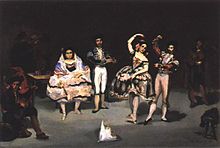
It is almost incommunicable to ascribe Manet's piece of work to whatever one era or style of art. Ane of his works that is truly on the brink of a new mode is Le Ballet Espagnol (1862).[one] The figures' contours coincide with their gestures equally a style to suggest depth in relation to i another and in relation to the setting. Manet also accentuates the lack of equilibrium in this work to project to the viewer that he or she is on the edge of a moment that is seconds abroad from passing. The blurred, hazy sense of color and shadow in this work similarly place the viewer in a fleeting moment.
In 1863, Manet extended his study of movement on apartment canvass with Le déjeuner sur l'herbe. The light, colour, and composition are the same, only he adds a new structure to the groundwork figures. The woman bending in the background is not completely scaled equally if she were far away from the figures in the foreground. The lack of spacing is Manet'south method of creating snapshot, near-invasive movement like to his blurring of the foreground objects in Le Ballet Espagnol.
Edgar Degas [edit]
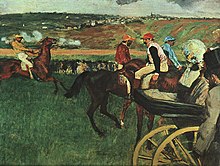
At the Races, 1877–1880, oil on canvas, by Edgar Degas, Musée d'Orsay, Paris
Edgar Degas is believed to be the intellectual extension of Manet, simply more radical for the impressionist community. Degas' subjects are the epitome of the impressionist era; he finds great inspiration in images of ballet dancers and horse races. His "modern subjects"[7] never obscured his objective of creating moving art. In his 1860 piece Jeunes Spartiates s'exerçant à la lutte, he capitalizes on the classic impressionist nudes but expands on the overall concept. He places them in a flat mural and gives them dramatic gestures, and for him this pointed to a new theme of "youth in motility".[8]
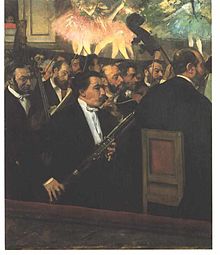
One of his near revolutionary works, Fifty'Orchestre de l'Opéra (1868) interprets forms of definite motion and gives them multidimensional motility across the flatness of the canvas. He positions the orchestra direct in the viewer's infinite, while the dancers completely fill the background. Degas is alluding to the Impressionist style of combining movement, simply almost redefines it in a fashion that was seldom seen in the late 1800s. In the 1870s, Degas continues this trend through his beloved of one-shot motion horse races in such works equally Voiture aux Courses (1872).
It wasn't until 1884 with Chevaux de Course that his attempt at creating dynamic art came to fruition. This work is part of a series of horse races and polo matches wherein the figures are well integrated into the mural. The horses and their owners are depicted equally if defenseless in a moment of intense deliberation, and then trotting away casually in other frames. The impressionist and overall artistic community were very impressed with this series, simply were also shocked when they realized he based this series on actual photographs. Degas was not fazed by the criticisms of his integration of photography, and it actually inspired Monet to rely on like technology.
Claude Monet [edit]
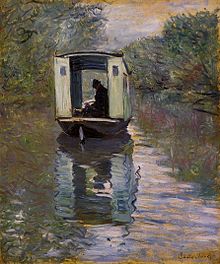
Degas and Monet's mode was very like in 1 way: both of them based their artistic estimation on a direct "retinal impression"[1] to create the feeling of variation and movement in their art. The subjects or images that were the foundation of their paintings came from an objective view of the world. As with Degas, many art historians consider that to be the hidden event photography had in that period of time. His 1860s works reflected many of the signs of motion that are visible in Degas' and Manet'south work.
By 1875, Monet's touch becomes very swift in his new series, beginning with Le Bâteau-Atelier sur la Seine. The landscape almost engulfs the whole canvas and has enough motility emanating from its inexact brushstrokes that the figures are a part of the move. This painting along with Gare Saint-Lazare (1877-1878), proves to many art historians that Monet was redefining the way of the Impressionist era. Impressionism initially was defined by isolating color, low-cal, and movement.[7] In the late 1870s, Monet had pioneered a style that combined all three, while maintaining a focus on the popular subjects of the Impressionist era. Artists were oft and so struck by Monet's wispy brushstrokes that information technology was more movement in his paintings, simply a striking vibration.[9]
Auguste Rodin [edit]
Auguste Rodin at start was very impressed by Monet's 'vibrating works' and Degas' unique understanding of spatial relationships. As an artist and an author of art reviews, Rodin published multiple works supporting this style. He claimed that Monet and Degas' work created the illusion "that art captures life through proficient modeling and motility".[nine] In 1881, when Rodin first sculpted and produced his ain works of art, he rejected his before notions. Sculpting put Rodin into a predicament that he felt no philosopher nor anyone could e'er solve; how tin artists impart movement and dramatic motions from works so solid as sculptures? After this conundrum occurred to him, he published new articles that didn't assault men such every bit Manet, Monet, and Degas intentionally, merely propagated his own theories that Impressionism is not about communicating motility but presenting it in static form.
20th century surrealism and early on kinetic art [edit]
The surrealist style of the 20th century created an piece of cake transition into the style of kinetic art. All artists at present explored field of study affair that would not have been socially acceptable to depict artistically. Artists went across solely painting landscapes or historical events, and felt the need to delve into the mundane and the extreme to interpret new styles.[10] With the support of artists such as Albert Gleizes, other avant-garde artists such as Jackson Pollock and Max Nib felt as if they had found new inspiration to notice oddities that became the focus of kinetic art.
Albert Gleizes [edit]
Gleizes was considered the ideal philosopher of the belatedly 19th century and early 20th century arts in Europe, and more specifically French republic. His theories and treatises from 1912 on cubism gave him a renowned reputation in whatsoever creative give-and-take. This reputation is what allowed him to human activity with considerable influence when supporting the plastic fashion or the rhythmic movement of art in the 1910s and 1920s. Gleizes published a theory on move, which farther articulated his theories on the psychological, artistic uses of movement in conjunction with the mentality that arises when considering movement. Gleizes asserted repeatedly in his publications that human creation implies the total renunciation of external awareness.[1] That to him is what made art mobile when to many, including Rodin, it was rigidly and unflinchingly immobile.
Gleizes offset stressed the necessity for rhythm in fine art. To him, rhythm meant the visually pleasant coinciding of figures in a 2-dimensional or three-dimensional space. Figures should exist spaced mathematically, or systematically so that they appeared to interact with one another. Figures should also non take features that are also definite. They demand to accept shapes and compositions that are nigh unclear, and from there the viewer can believe that the figures themselves are moving in that confined space. He wanted paintings, sculptures, and fifty-fifty the flat works of mid-19th-century artists to bear witness how figures could impart on the viewer that in that location was smashing movement contained in a sure space. As a philosopher, Gleizes also studied the concept of artistic move and how that appealed to the viewer. Gleizes updated his studies and publications through the 1930s, just as kinetic art was becoming popular.
Jackson Pollock [edit]
When Jackson Pollock created many of his famous works, the The states was already at the forefront of the kinetic and popular art movements.[ citation needed ] The novel styles and methods he used to create his well-nigh famous pieces earned him the spot in the 1950s equally the unchallenged leader of kinetic painters, his work was associated with Activity painting coined by art critic Harold Rosenberg in the 1950s.[ citation needed ] Pollock had an unfettered desire to breathing every aspect of his paintings.[ citation needed ] Pollock repeatedly said to himself, "I am in every painting".[eight] He used tools that most painters would never use, such as sticks, trowels, and knives. He thought of the shapes he created as being "beautiful, erratic objects".[8]
This style evolved into his drip technique. Pollock repeatedly took buckets of paint and paintbrushes and flicked them effectually until the canvas was covered with squiggly lines and jagged strokes. In the next phase of his work, Pollock tested his mode with uncommon materials. He painted his outset piece of work with aluminum paint in 1947, titled Cathedral and from at that place he tried his first "splashes" to destroy the unity of the material itself.[ commendation needed ] He believed wholeheartedly that he was liberating the materials and structure of art from their forced confinements, and that is how he arrived at the moving or kinetic art that always existed.[ citation needed ]
Max Bill [edit]
Max Pecker became an almost complete disciple of the kinetic movement in the 1930s. He believed that kinetic art should be executed from a purely mathematical perspective.[ commendation needed ] To him, using mathematics principles and understandings were ane of the few ways that yous could create objective move.[ commendation needed ] This theory applied to every artwork he created and how he created it. Statuary, marble, copper, and brass were four of the materials he used in his sculptures.[ citation needed ] He also enjoyed tricking the viewer's eye when he or she first approached one of his sculptures.[ citation needed ] In his Construction with Suspended Cube (1935-1936) he created a mobile sculpture that generally appears to accept perfect symmetry, simply once the viewer glances at it from a different bending, there are aspects of asymmetry.[ citation needed ]
Mobiles and sculpture [edit]
Max Bill's sculptures were only the outset of the style of movement that kinetic explored. Tatlin, Rodchenko, and Calder specially took the stationary sculptures of the early 20th century and gave them the slightest freedom of motility. These 3 artists began with testing unpredictable move, and from there tried to control the movement of their figures with technological enhancements. The term "mobile" comes from the power to modify how gravity and other atmospheric conditions touch on the artist's piece of work.[7]
Although in that location is very fiddling distinction between the styles of mobiles in kinetic art, there is one distinction that tin exist made. Mobiles are no longer considered mobiles when the spectator has control over their movement. This is 1 of the features of virtual movement. When the slice only moves under certain circumstances that are not natural, or when the spectator controls the movement fifty-fifty slightly, the figure operates under virtual movement.[ citation needed ]
Kinetic fine art principles have as well influenced mosaic fine art. For instance, kinetic-influenced mosaic pieces oft use clear distinctions betwixt bright and dark tiles, with three-dimensional shape, to create apparent shadows and movement.[11]
Vladimir Tatlin [edit]
Russian artist and founder-member of the Russian Constructivism movement Vladimir Tatlin is considered by many artists and fine art historians[ who? ] to exist the start person to ever consummate a mobile sculpture.[ commendation needed ] The term mobile wasn't coined until Rodchenko's time,[ citation needed ] merely is very applicable to Tatlin's work. His mobile is a serial of suspended reliefs that only demand a wall or a pedestal, and it would forever stay suspended. This early mobile, Contre-Reliefs Libérés Dans Fifty'espace (1915) is judged as an incomplete work. It was a rhythm, much similar to the rhythmic styles of Pollock, that relied on the mathematical interlocking of planes that created a piece of work freely suspended in air.[ citation needed ]
Tatlin's Belfry or the project for the 'Monument to the Third International' (1919–20), was a blueprint for a awe-inspiring kinetic architecture building that was never built.[12] Information technology was planned to be erected in Petrograd (now St. Petersburg) after the Bolshevik Revolution of 1917, equally the headquarters and monument of the Comintern (the Tertiary International).
Tatlin never felt that his art was an object or a production that needed a clear first or a clear end. He felt above anything that his work was an evolving procedure. Many artists whom he befriended considered the mobile truly complete in 1936, but he disagreed vehemently.[ citation needed ]
Alexander Rodchenko [edit]
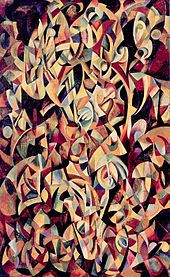
Alexander Rodchenko Dance. An Objectless Limerick, 1915
Russian creative person Alexander Rodchenko, Tatlin's friend and peer who insisted his work was consummate, continued the written report of suspended mobiles and created what he accounted to be "non-objectivism".[1] This style was a report less focused on mobiles than on canvas paintings and objects that were immovable. Information technology focuses on juxtaposing objects of unlike materials and textures as a fashion to spark new ideas in the heed of the viewer. By creating discontinuity with the work, the viewer causeless that the figure was moving off the canvas or the medium to which it was restricted. Ane of his canvas works titled Dance, an Objectless Composition (1915) embodies that desire to place items and shapes of different textures and materials together to create an prototype that drew in the viewer's focus.
However, by the 1920s and 1930s, Rodchenko establish a way to incorporate his theories of non-objectivism in mobile study. His 1920 piece Hanging Construction is a wood mobile that hangs from any ceiling by a string and rotates naturally. This mobile sculpture has concentric circles that exist in several planes, but the entire sculpture just rotates horizontally and vertically.
Alexander Calder [edit]

Alexander Calder is an artist who many believe to have defined firmly and exactly the style of mobiles in kinetic art. Over years of studying his works, many critics allege that Calder was influenced by a broad diverseness of sources. Some claim that Chinese windbells were objects that closely resembled the shape and height of his earliest mobiles. Other art historians argue that the 1920s mobiles of Man Ray, including Shade (1920) had a directly influence on the growth of Calder's fine art.
When Calder get-go heard of these claims, he immediately admonished his critics. "I have never been and never volition exist a product of anything more than myself. My art is my ain, why carp stating something about my art that isn't true?"[8] One of Calder's first mobiles, Mobile (1938) was the work that "proved" to many art historians that Man Ray had an obvious influence on Calder'due south style. Both Shade and Mobile have a single string attached to a wall or a structure that keeps it in the air. The ii works have a crinkled characteristic that vibrates when air passes through it.
Regardless of the obvious similarities, Calder's style of mobiles created ii types that are now referred to as the standard in kinetic art. In that location are object-mobiles and suspended mobiles. Object mobiles on supports come in a broad range of shapes and sizes and can move in any way. Suspended mobiles were first made with colored glass and small wooden objects that hung on long threads. Object mobiles were a office of Calder's emerging way of mobiles that were originally stationary sculptures.
Information technology can exist argued, based on their similar shape and opinion, that Calder's earliest object mobiles have very petty to do with kinetic fine art or moving art. By the 1960s, virtually art critics believed that Calder had perfected the way of object mobiles in such creations as the True cat Mobile (1966).[13] In this piece, Calder allows the cat's head and its tail to exist subject area to random move, merely its body is stationary. Calder did not start the tendency in suspended mobiles, but he was the artist that became recognized for his apparent originality in mobile construction.
One of his earliest suspended mobiles, McCausland Mobile (1933),[14] is different from many other contemporary mobiles simply because of the shapes of the ii objects. Most mobile artists such as Rodchenko and Tatlin would never have thought to use such shapes because they didn't seem malleable or even remotely aerodynamic.
Despite the fact that Calder did not divulge most of the methods he used when creating his work, he admitted that he used mathematical relationships to make them. He only said that he created a balanced mobile by using straight variation proportions of weight and distance. Calder'south formulas changed with every new mobile he made, and then other artists could never precisely imitate the piece of work.
Virtual movement [edit]
By the 1940s, new styles of mobiles, as well equally many types of sculpture and paintings, incorporated the control of the spectator. Artists such as Calder, Tatlin, and Rodchenko produced more art through the 1960s, but they were also competing against other artists who appealed to different audiences. When artists such as Victor Vasarely developed a number of the first features of virtual movement in their art, kinetic art faced heavy criticism. This criticism lingered for years until the 1960s, when kinetic art was in a dormant menstruation.
Materials and electricity [edit]
Vasarely created many works that were considered to exist interactive in the 1940s. I of his works Gordes/Cristal (1946) is a series of cubic figures that are also electrically powered. When he kickoff showed these figures at fairs and art exhibitions, he invited people up to the cubic shapes to press the switch and start the color and light show. Virtual move is a way of kinetic art that tin can exist associated with mobiles, just from this style of motility there are ii more specific distinctions of kinetic fine art.
Credible motion and op fine art [edit]
Apparent motion is a term ascribed to kinetic fine art that evolved only in the 1950s. Art historians believed that any type of kinetic art that was mobile independent of the viewer has apparent movement. This style includes works that range from Pollock's drip technique all the manner to Tatlin's first mobile. Past the 1960s, other art historians developed the phrase "op fine art" to refer to optical illusions and all optically stimulating art that was on canvas or stationary. This phrase often clashes with certain aspects of kinetic art that include mobiles that are by and large stationary.[15] [16]
In 1955, for the exhibition Mouvements at the Denise René gallery in Paris, Victor Vasarely and Pontus Hulten promoted in their "Yellow manifesto" some new kinetic expressions based on optical and luminous phenomenon equally well as painting illusionism. The expression "kinetic art" in this modernistic form first appeared at the Museum für Gestaltung of Zürich in 1960, and plant its major developments in the 1960s. In most European countries, it generally included the grade of optical fine art that mainly makes apply of optical illusions, such equally op art, represented by Bridget Riley, as well as art based on movement represented past Yacov Agam, Carlos Cruz-Diez, Jesús Rafael Soto, Gregorio Vardanega, Martha Boto or Nicolas Schöffer. From 1961 to 1968, GRAV (Groupe de Recherche d'Fine art Visuel) founded by François Morellet, Julio Le Parc, Francisco Sobrino, Horacio Garcia Rossi, Yvaral, Joël Stein and Vera Molnár was a collective grouping of opto-kinetic artists. According to its 1963 manifesto, GRAV appealed to the direct participation of the public with an influence on its behavior, notably through the use of interactive labyrinths.
Contemporary work [edit]
In November 2013, the MIT Museum opened 5000 Moving Parts, an exhibition of kinetic fine art, featuring the work of Arthur Ganson, Anne Lilly, Rafael Lozano-Hemmer, John Douglas Powers, and Takis. The exhibition inaugurates a "year of kinetic art" at the Museum, featuring special programming related to the artform.[17]
Neo-kinetic[ clarification needed ] art has been popular in China where you lot tin can find interactive kinetic sculptures in many public places, including Wuhu International Sculpture Park and in Beijing.[18]
Changi Drome, Singapore has a curated collection of artworks including large-scale kinetic installations by international artists ART+COM and Christian Moeller.[ citation needed ]
Selected works [edit]
-

-

-
-

-
-

Uli Aschenborn, if the onlooker passes this 'chameleon-painting' Magic Dice information technology shows ane, 2 or three pips and its color changes - sand and pigment, Namibia
-
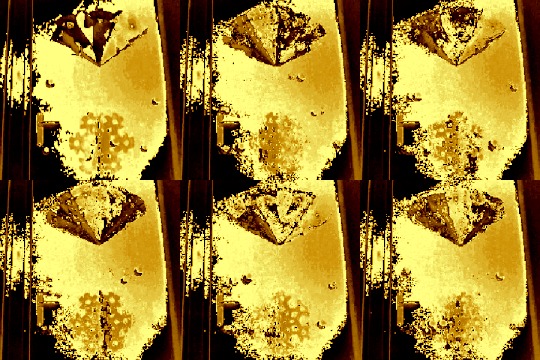
Sarnikoff 'Goldflakes' Mobile cardboard animated by an asynchronous motor, also recycle art to bring spirit in this contribution French republic
-

Selected kinetic sculptors [edit]
- Yaacov Agam
- Uli Aschenborn
- David Ascalon
- Fletcher Benton
- Marker Bischof
- Daniel Buren
- Alexander Calder
- Gregorio Vardanega
- Martha Boto
- U-Ram Choe
- Angela Conner
- Carlos Cruz-Diez
- Marcel Duchamp
- Lin Emery
- Rowland Emett
- Arthur Ganson
- Nemo Gould
- Gerhard von Graevenitz
- Bruce Gray
- Ralfonso Gschwend
- Rafael Lozano-Hemmer
- Chuck Hoberman
- Anthony Howe
- Irma Hünerfauth
- Tim Hunkin
- Theo Jansen
- Ned Kahn
- Roger Katan
- Starr Kempf
- Frederick Kiesler
- Viacheslav Koleichuk
- Gyula Kosice
- Gilles Larrain
- Julio Le Parc
- Liliane Lijn
- Len Lye
- Sal Maccarone
- Heinz Mack
- Phyllis Mark
- László Moholy-Nagy
- Alejandro Otero
- Robert Perless
- Otto Piene
- George Rickey
- Ken Rinaldo
- Barton Rubenstein
- Nicolas Schöffer
- Eusebio Sempere
- Jesús Rafael Soto
- Mark di Suvero
- Takis
- Jean Tinguely
- Wen-Ying Tsai
- Marc van den Broek
- Panayiotis Vassilakis
- Lyman Whitaker
- Ludwig Wilding
Selected kinetic op artists [edit]
- Nadir Afonso
- Getulio Alviani
- Marina Apollonio
- Carlos Cruz-Díez
- Ronald Mallory
- Youri Messen-Jaschin
- Vera Molnár
- Abraham Palatnik
- Bridget Riley
- Eusebio Sempere
- Grazia Varisco
- Victor Vasarely
- Jean-Pierre Yvaral
- Romano Rizzato
See too [edit]
- Barrier-grid animation § Kinegram
- Gas sculpture
- Lumino kinetic art
- Robotic art
- Audio art
- Sound installation
References [edit]
- ^ a b c d eastward Popper, Frank (1968). Origins and Development of Kinetic Art. New York Graphic Social club.
- ^ Lijn, Liliane (2018-06-11). "Accepting the Machine: A Response by Liliane Lijn to Three Questions from Arts". Arts. 7 (2): 21. doi:10.3390/arts7020021.
- ^ Popper, Frank (2003), "Kinetic fine art", Oxford Art Online, Oxford Academy Press, doi:10.1093/gao/9781884446054.article.t046632
- ^ a b Leaper, Laura E. (2010-02-24), "Kinetic art in America", Oxford Art Online, Oxford University Press, doi:10.1093/gao/9781884446054.article.t2085921
- ^ Popper, Frank. Kinetics.
- ^ Brett, Guy (1968). Kinetic fine art. London, New York: Studio-Vista. ISBN978-0-289-36969-2. OCLC 439251.
- ^ a b c Kepes, Gyorgy (1965). The Nature and Art of Motility. Thou. Braziller.
- ^ a b c d Malina, Frank J. Kinetic Fine art: Theory and Exercise .
- ^ a b Roukes, Nicholas (1974). Plastics for Kinetic Art. Watson-Guptill Publications. ISBN978-0-8230-4029-two.
- ^ Giedion-Welcker, Carola (1937). Modern Plastic Fine art, Elements of Reality, Volume and Disintegration. H. Girsberger.
- ^ Menhem, Chantal. "Kinetic Mosaics: The Fine art of Movement". Mozaico . Retrieved 8 August 2017.
- ^ Janson, H.Due west. (1995). History of Art. 5th ed., Revised and expanded past Anthony F. Janson. London: Thames & Hudson. p. 820. ISBN0500237018.
- ^ Mulas, Ugo; Arnason, H. Harvard. Calder . with comments by Alexander Calder.
- ^ Marter, Joan M. (1997). Alexander Calder. Cambridge University Press. ISBN978-0-521-58717-four.
- ^ "Op art". Encyclopedia Britannica.
- ^ "Fine art cinétique". Site Internet du Centre Pompidou (in French).
- ^ "5000 Moving Parts". MIT Museum. MIT Museum. Retrieved 2013-11-29 .
- ^ Gschwend, Ralfonso (22 July 2015). "The Development of Public Art and its Future Passive, Active and Interactive Past, Present and Hereafter". Arts. 4 (three): 93–100. doi:10.3390/arts4030093.
Further reading [edit]
- Terraroli, Valerio (2008). The Birth of Contemporary Art: 1946-1968 . Rizzoli Publishing. ISBN9788861301948.
- Tovey, John (1971). The Technique of Kinetic Art. David and Charles. ISBN9780713425185.
- Selz, Peter Howard (1984). Theories of Mod Art: A Source Book by Artists and Critics . University of California Press. ISBN9780520052567.
- Selz, Peter; Chattopadhyay, Collette; Ghirado, Diane (2009). Fletcher Benton: The Kinetic Years. Hudson Hills Press. ISBN9781555952952.
- Marks, Mickey K. (1972). Op-Tricks: Creating Kinetic Art . Lippincott Williams & Wilkins. ISBN9780397312177.
- Diehl, Gaston (1991). Vasarely. Crown Publishing Group. ISBN9780517508008.
- Milner, John (2009). Rodchenko: Blueprint. Antique Collector's Club. ISBN9781851495917.
- Bott Casper, Gian (2012). Tatlin: Art for a New Earth. Hatje Cantz Verlag GmbH & Co KG. ISBN9783775733632.
- Toynton, Evelyn (2012). Jackson Pollock . Yale University Press. ISBN9780300192506.
External links [edit]
- Kinetic Art Arrangement (KAO) - KAO - Largest International Kinetic Art Organisation (Kinetic Art pic and book library, KAO Museum planned)
Source: https://en.wikipedia.org/wiki/Kinetic_art
0 Response to "Alexander Calders Mobiles Are Examples of Kinetic Art Because They"
Post a Comment