Reading Spark Plugs in a Acvw Turbocharged Engine
For many racing engines, spark plug color is a window into the engine combustion process that tin can be used for tuning. Without knowing your system inside and out, notwithstanding, tuning with spark plug color lonely can be misleading.
Exposure to estrus and combustion byproducts changes the colors on the various parts of the spark plug. Heat is the catalyst of spark plug color changes in whatever of these sections. Excess heat can come up from the combustion procedure or the engine cylinder head temperature. However, a heat indication in one spark plug department may not produce a heat indication in another department of the spark plug.
The spark plug has several sections to read to decide the engine tune-up: the porcelain, the housing band effectually the porcelain, the strap or outer electrode, the center electrode shape, and the threads. The porcelain is the insulator between the center electrode and the spark plug housing. On a new spark plug, it starts out white. After a examination run, the spark plug can be examined with the naked heart or under a magnifying glass for minute particles, cracking, or surface bubbling.
With a deeper analysis, a spark plug tin can exist cut open to wait at the porcelain downwards deep into the housing. Nevertheless, for this article, we volition simply talk over discoloration of the visible part of the porcelain.
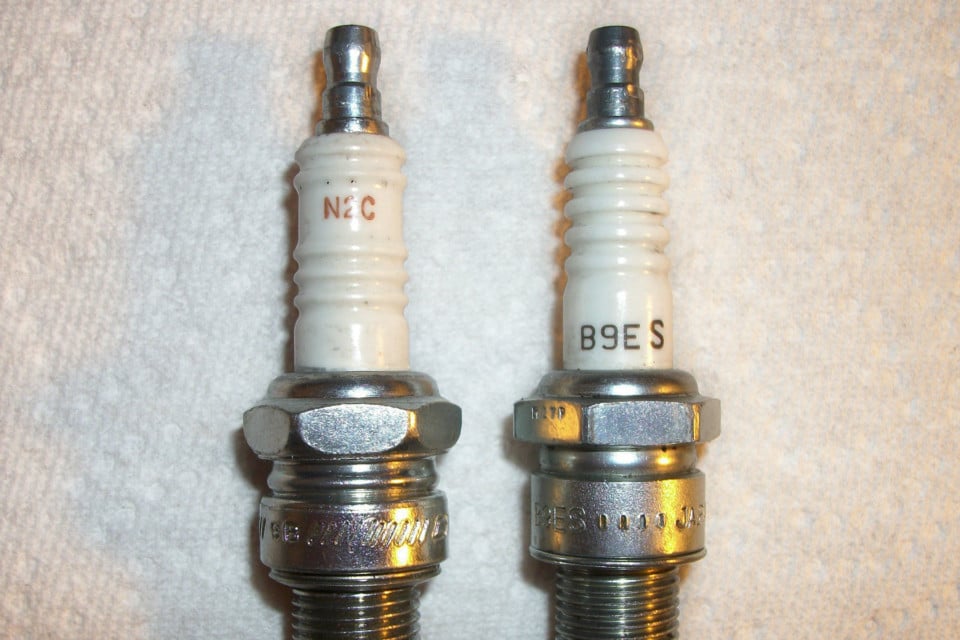
These spark plugs are from different manufacturers. Platings from different manufacturers discolor at unlike temperatures. Some tuners recommend staying with one brand of spark plug to avoid differences in temperature readings from different suppliers.
Spark Plugs and Gasoline Fuels
For gasoline fuels, the residuals of carbon compounds from rich mixtures of gasoline fuels can cause discoloration. Proper gasoline fuel mixtures for long endurance racing ordinarily leave just a faint porcelain discoloration. However, discoloration tin increase with more than racing mileage.
In racing engines with carburetors, excessive accelerator pump volume can send a surge of rich mixture into the engine that may or may non clean upwardly with higher engine speed. Repeatedly rapping the throttle is a tease to the carbon build-upward on the spark plug porcelain.
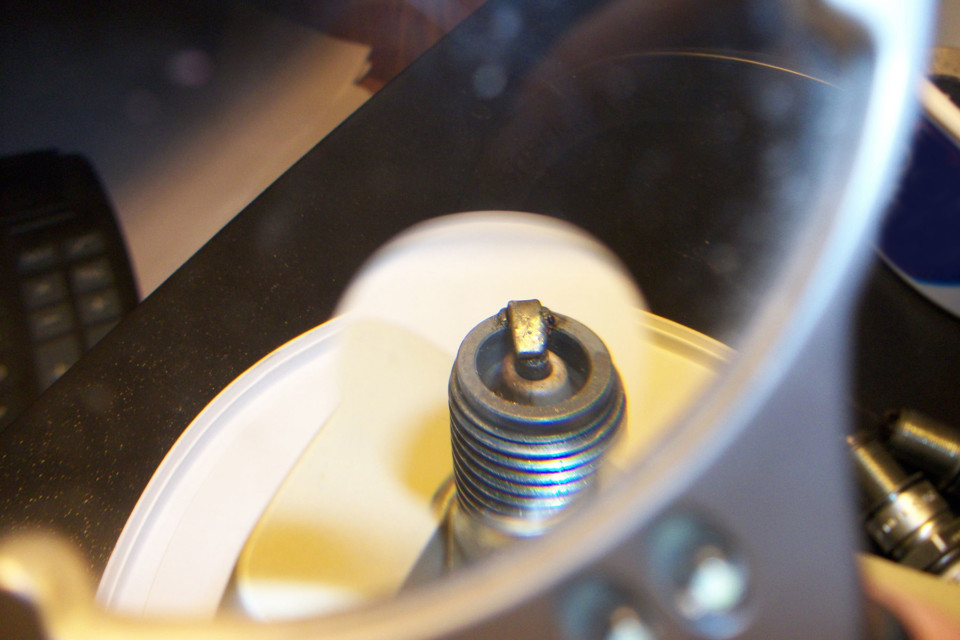
This spark plug is examined under a magnifying glass to inspect for porcelain, strap, and housing discolorations as tuning indicators.
Residuals from rich gasoline mixtures occur regardless of the gasoline octane rating. Low-octane, equally well as loftier-octane gasoline fuels in a rich mixture leave carbon chemical compound deposits on the spark plug porcelain. However, lower octane fuels should run hotter in some engines because of a more than rapid ignition flame speed. This leaves more oestrus indications in spark plugs from lower octane fuels. Engines that run hotter due to lower-octane gasoline may burn off more residuals in some cases, whereas more residuals may build-up from an engine using higher octane fuels.
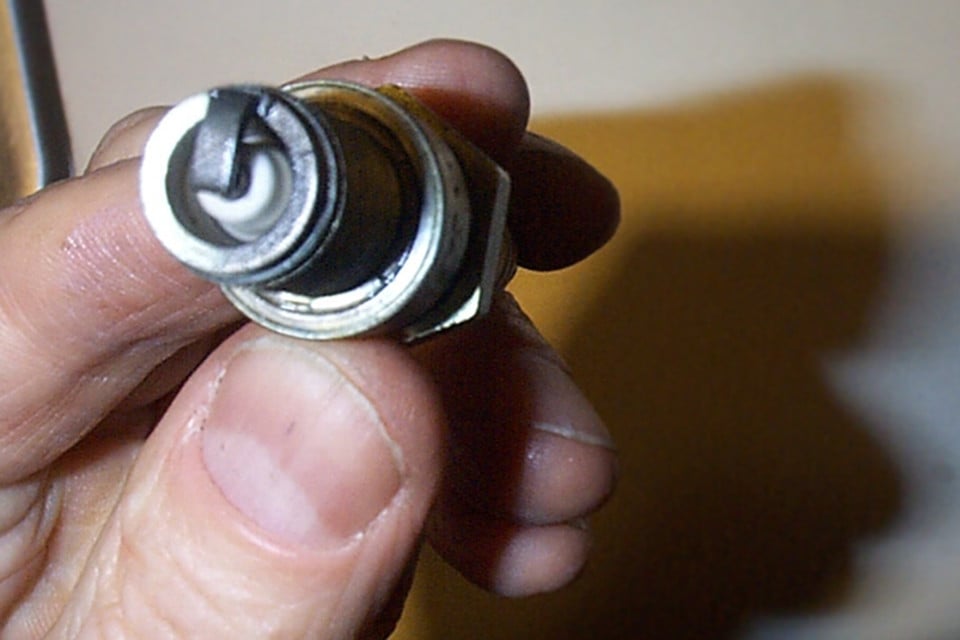
White porcelain showing no signs of carbon build-up, neat, peppering, or oil deposits is considered an ideal spark plug later a run. Half of the ring around the spark plug shows discoloration from oestrus. The other half is not discolored. This is a mutual baseline goal with many tuners. The outer strap shows reasonable (ideal) oestrus indication at the bend, although not visible from the photo.
Rich and lean gasoline mixtures
As yous can judge, rich gasoline mixtures volition discolor the porcelain. Besides being an indicator of mixture content, excess carbon build-up is electrically conductive and drains the strength of the spark, reducing ability. Some tuners offset that effect with increased spark advance. We've seen ignition advances of ten- to fifteen-degrees more baseline values to offset a weak ignition. Performance was well-nigh the same with the increased spark advance compensation in several of our drag racing setups.
Stoichiometric mixtures of gasoline do not provide much discoloration. Gasoline mixtures up to a certain point on the lean side may increment engine operating temperature and show signs of rut on the plug. Without an adequate cooling system, a lean condition tin can cause overheating, pre-ignition, or even detonation, which could crusade porcelain failure. If engines are run even leaner across that betoken, the engine may be showing signs of running libation because of inadequate fuel burning with all of the excessive air going through the engine. Reading the combustion temperature from a plug is not necessarily a good indication of fuel mixture leanness, by itself.
Spark Plugs and Booze Fuels
For alcohol fuels, there are essentially no fuel residuals on the porcelain from rich mixtures, including pure ethanol (99-plus-percent) or pure methanol. This ways that porcelain color remains white after running with ethanol or methanol. These fuels do non have carbon deposits from normal combustion like gasoline mixtures. When porcelain discoloration occurs with pure alcohol fuels, it is from oil burning deposits.
E85 is becoming more common in racing. It is reported to somewhen build-up gasoline deposits if the mixtures are rich, although the excessive alcohol content tends to clean the spark plug porcelain, making it tough to read the color of the porcelain every bit a tuning guide.
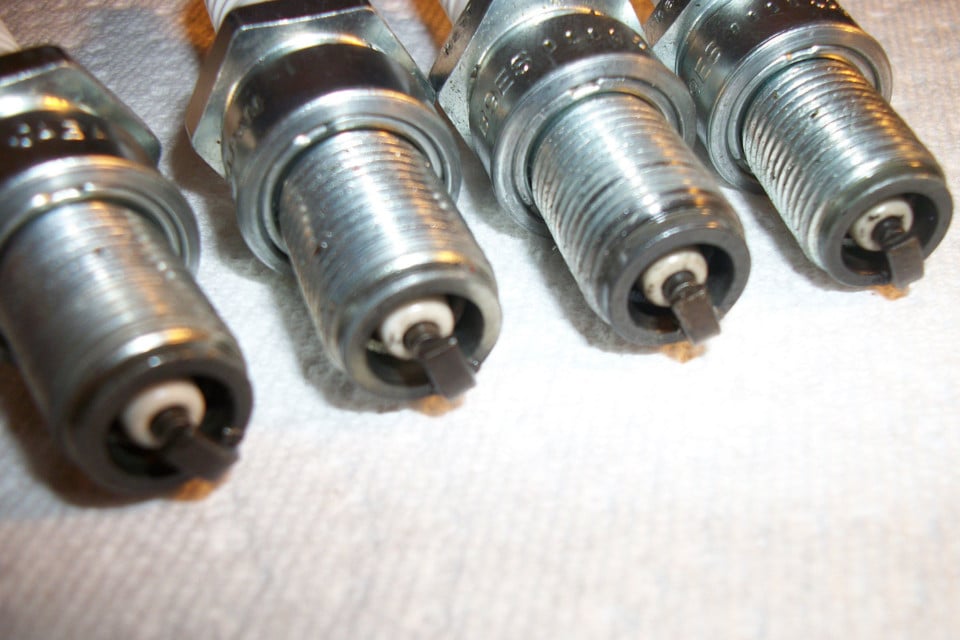
This set of iv spark plugs from one bank of cylinders from a V8 engine shows various porcelain indications including oil burning, cracking (second from correct), and peppering. Note that spark plug threads do not evidence as distinct of a variation in color changes. Reading the porcelain condition is key.
Rich and Lean Booze Mixtures
Lean mixtures of booze fuels can provide misleading results. Excessively lean mixtures may effect in cold combustion from inadequate fuel. This can leave a wet, uncolored spark plug housing looking similar a rich mixture, when the opposite is really truthful.
Slightly lean mixtures of booze fuels should get out no colour from the fuels too. If engine temperature is excessive from the lean mixture, porcelain failure may occur. This includes surface failure, cracking, and peppering of the surface from burnt metal particles from the engine.
Of note, is that well-nigh racing engines running alcohol fuels run very high compression ratios. Supercharged engines commonly run high compression and high boost. To prevent detonation and overheating, overly rich alcohol fuel mixtures are anywhere from fifteen-pct rich to 100-pct rich. Richer mixtures are also used in engines with marginal cooling systems, as they work well at cooling an engine. In these cases, running without enough fuel enrichment can cause overheating. These overheating engines may nevertheless exist very rich from a stoichiometric standpoint, simply not rich enough to maintain the cooling effect desired.
Conversely, lean spark plug indications from excess engine heat can really exist made with a rich alcohol fuel mixture. Tape-running dart car engine temperatures are typically run at 220°F cooling arrangement temperature. In comparison, high-performance racing engines on the street are usually not run over 200°F cooling organization temperature. The sprint car with good oil control and the street engine should both take white spark plug porcelain.
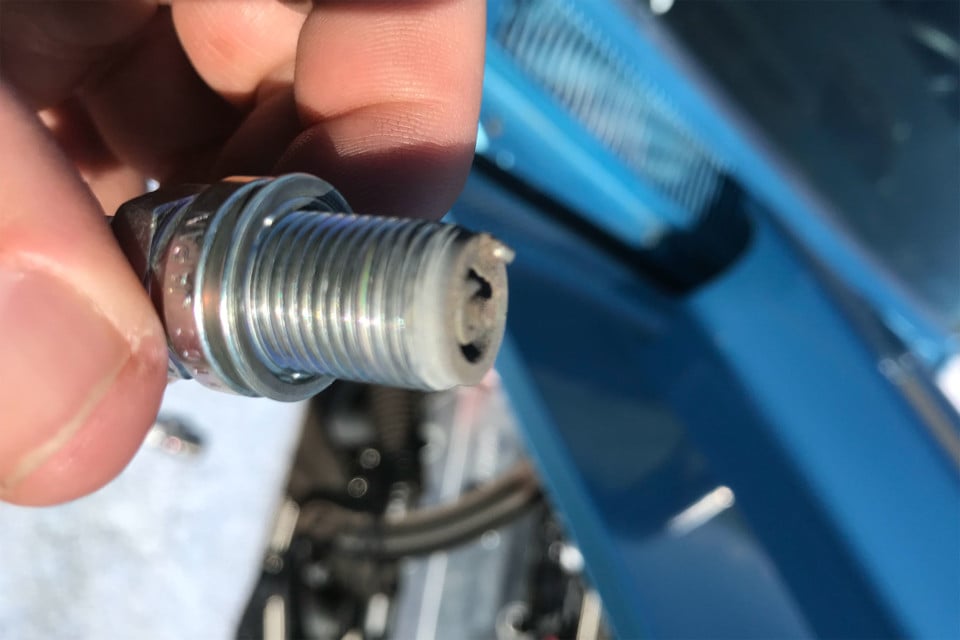
This illustrates the bright window into a melody-up from reading the spark plug. The strap has burned off. Metal deposits are all over the porcelain and housing. Note there are simply 2 rings of oestrus discoloration in threads. This demonstrates an overly lean status simply with non very much time under load.
Discoloration from engine oil unremarkably shows as a dark build-up, ranging from a slight discoloration to a completely night color. This occurs with carbon build-up from excessive oil consumption, coming from one or several sources:
- Engine oil blow-by from rings
- Leaking effectually valve guides from excessive valve guide clearance or failed valve guide seals
- Engine oil leaking into the intake tract such as from:
- Bad caput gasket
- For engines where pushrod guide tubes run into the intake ports: unwanted leaking between the tube and the port casting, forging, or barracks
- Intake port casting failure.
Spark Plugs and Nitro Fuels
Nitromethane and mixtures of nitromethane and methanol do non leave carbon deposits on porcelain from rich mixtures. Other colors may appear such as peppering or dandy due to excess temperatures, from detonation, or inadequate cooling from combustion temperatures.
Spark plug porcelain indications can occur when running low percentages of nitro with methanol. In our elevate race engine testing, we ran a examination program for various percentages of nitro ranging from half dozen-per centum upwards to 30-percent. With skilful air/fuel ratio mixture control, nosotros saw porcelain indications similar to spark plug reading from directly methanol. Although, starting at 6-percent, porcelain cracking and peppering occurred in a couple of cylinders due to uneven fuel distribution from our manifold and blower arrangement, even though the overall air/fuel mixture was well-defined and gear up. This prompted the addition of port nozzles to even out the fuel distribution. Spark plug readings from then on were quite even across all eight cylinders and similar to those of straight methanol.
We did not run across this porcelain sensitivity on straight methanol mixtures. Overall air/fuel ratio was rich, but because of fuel distribution issues, information technology was only not rich enough on a couple of cylinders to preclude porcelain failure with even low percentages of nitro. Nitro is sensitive if it is wrong!
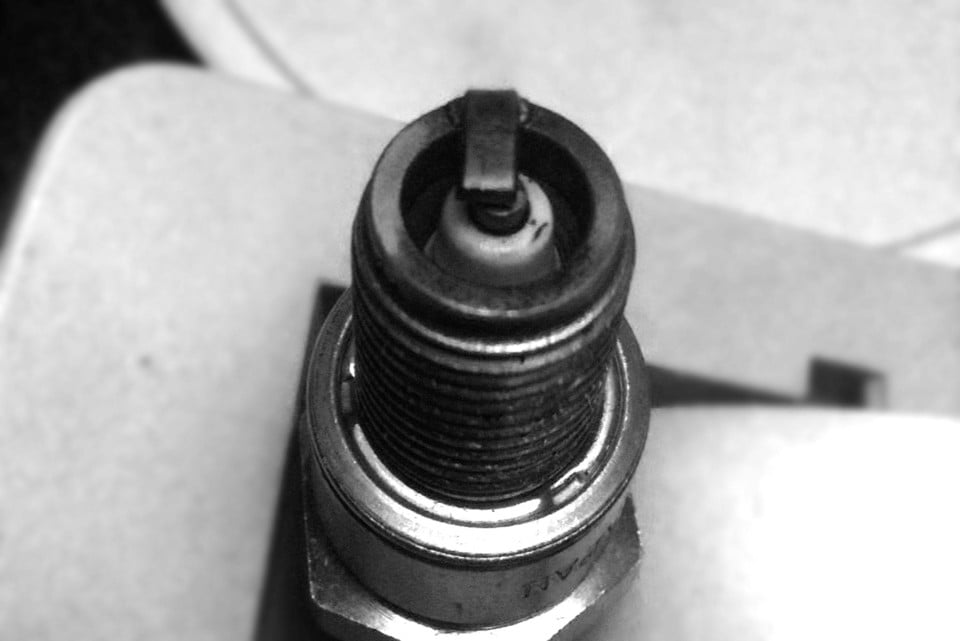
Various color indications on a spark plug after i drag racing exam run using half dozen-percentage nitro. Under a magnifying glass (not necessarily visible to the naked eye), the porcelain shows a crack at the 6:00 location and peppering from burnt metal flakes. The electrode strap shows color all the mode to the weld, indicating high combustion temperatures. There is some strap melting on the edges. Fuel distribution was through a fuel injection hat to a blower on elevation of a blower manifold feeding fuel and air to a race Hemi V8. The addition of fuel injection port nozzles afterwards alleviated this trouble.
Other events that discolor spark plugs
Regardless of the fuel, detonation can crusade porcelain failure. Surface failure and cracking may appear along with metallic peppering on the porcelain (metal flakes) from overheating the pistons.
Lean mixtures including those that are stoichiometricly rich, but simply not rich enough, tin cause overheating. This can cause failure of one or more than engine parts. Pistons can melt, ruining the piston ring seal, causing excess engine oil consumption. In more dramatic failures, a burned hole in the piston can ignite engine oil causing a burn. If either occurs and is caught earlier engine meltdown, spark plug porcelain should bear witness excessive carbon compound buildup from oil consumption. Where alcohol or nitro fuels are used, porcelain color change would non be from the fuel deposits.
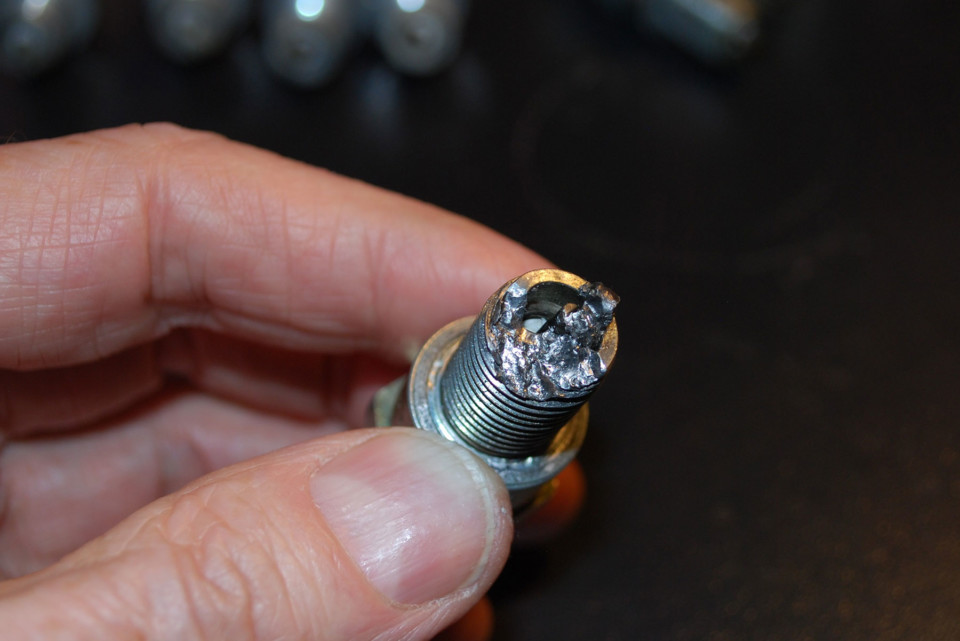
When it is probably non the fuel system, component failures in a racing engine can destroy the spark plug end. Notation that there is no discoloration of the threads and no plating discoloration of the outer ring. This indicates a rich running engine that was probably down on power.
Spark Plug Readings from Air Density Changes
When racing with gasoline at lower air densities, porcelain will evidence richness without fuel mixture adjustment. At college air densities, porcelain color may bear witness leanness without a fuel mixture adjustment. It is possible with a lean mixture to non make enough estrus to show any heat indication on the spark plug. Often, this is mistaken equally a rich condition where the tuner leans the engine farther making information technology colder nevertheless. Exhaust temperature sensors tin can produce misleading results in this case as well. Controlling the actual air/fuel ratio is a good way to avoid this.
When racing with alcohol fuels at depression or high air densities, porcelain colour should not point a deviation. Other indicators such as spark plug housing discoloration from engine heat, engine temperature, and sometimes exhaust thermocouples are needed for tuning. Still, the exhaust thermocouples may produce misleading data when engine temperatures are high if it is from afterwards-burning in the exhaust. This tin crusade a misleading indication of an overly lean or rich engine.
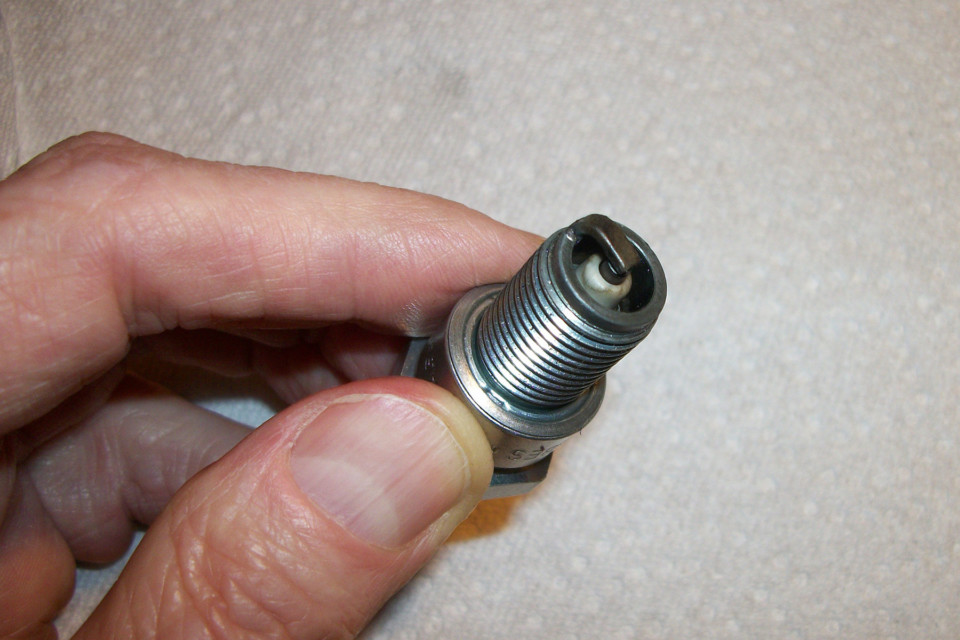
Nighttime stains on porcelain are usually from oil burning. A muddy strap adds show to oil burning suspicion. Burning oil is common in supercharged racing engines that are oftentimes run without intake valve stem seals, as heave tends to blow them away so they are often left off. This leads to oil burning from intake vacuum at idle.
In summary
For gasoline fuels, porcelain color is a adept indicator of a rich or lean mixture besides equally tuning needs from air density changes. For alcohol fuels, all the same, porcelain color is non a adept tuning indicator for dissimilar mixtures or different air densities. It must be remembered that porcelain colour tin can be masked by backlog oil consumption leading to carbon compound build-up and loss of ignition strength.
Peppering on the porcelain is a expert indication of an engine that is overheating and causing metal particles to suspension abroad from the piston, appearing as burnt specks on the porcelain. Finally, porcelain groovy is a expert indication of engine overheating and/or detonation. So, while a useful tool in the toolbox for determining the engine's tune-up, reading plugs can be tricky, and should not exist your sole source of information in tuning your engine.
Spark Plug Indicators By Fuel
GASOLINE
- Stoichiometric mixtures offer little to no color. Still, slight discoloration of the porcelain can be expected with a correct air-fuel mixture over extended periods of employ. The longer the period of use, the darker the colour.
- A rich mixture results in a dark porcelain coloration from carbon buildup. The darker the colour, the richer the mixture is.
- A lean mixture can be indicated past excessive heat indicators on the plug and footing strap. Excessively lean mixtures will show a "peppering" of carbon on the insulator from detonation, and in even more extreme cases, cracking of the porcelain.
ALCOHOL
- No porcelain discoloration should occur in normal apply with alcohol-based fuels, making porcelain color a poor indicator of air/fuel ratio. Porcelain discoloration in an alcohol application indicates the presence of oil in the combustion process.
- A rich mixture can show similar estrus signs to that of a lean plug, without the peppering or porcelain damage. Extremely rich conditions leave a wet plug with minimal signs of oestrus throughout the plug and ground strap.
- A light to moderate lean status volition prove signs of excessive heat in the plug, moving into peppering and porcelain failure from detonation. Extremely lean atmospheric condition can prove misleading signs of being rich, with a wet plug and lack of estrus, similar to an excessively rich mixture.
NITROMETHANE
- Nitro, similar alcohol, doesn't go out carbon deposits so the color of the porcelain is non an indicator.
- A rich mixture of nitro tin can result in porcelain peppering and cracking from excess heat and detonation, or inadequate cooling.
- A lean nitro mixture can also event in keen and peppering of the porcelain.
Source: https://www.enginelabs.com/engine-tech/reading-the-plugs-spark-plug-tuning-with-different-fuels/
0 Response to "Reading Spark Plugs in a Acvw Turbocharged Engine"
Post a Comment